
Pool Tile & Coping Replacement: Do You Need to Drain or Resurface Too?
Loose waterline tile and cracked coping raise two questions: does the pool need draining, and should it be resurfaced too? Here is what the sources say.
Orlando FL Pool Resurfacing is a free quote service. We connect Orlando-area homeowners with independent local pool contractors for free, no-obligation quotes. The contractor you choose quotes, contracts and does the work.
Waterline tile and coping take more abuse than most of a pool: sun, splashing, foot traffic and the edge of the deck. When tile loosens or coping cracks, two practical questions follow. Does the pool have to be drained? Should the interior be resurfaced at the same time? This guide answers them as far as the research behind this site goes, then covers materials, typical prices and who may do the work.
Do you need to drain, or resurface too?
Research for this site found no source that settles either question for every pool. Whether tile can be replaced with the water lowered rather than fully drained depends on how much tile is involved, where it is, and the contractor’s method. Whether to resurface at the same time depends on the condition of the finish. A contractor who has seen the pool is the right person to answer both, and it is fair to ask each one to explain the choice in writing.
A few sourced points help frame the decision:
- Draining is licensed work. Florida’s swimming pool/spa servicing license covers “the substantial or complete draining of a swimming pool… for the purpose of repair or renovation” (Fla. Stat. §489.105(3)(l)).
- Drain water has rules. If water leaves the pool, Orange County asks owners to stop adding chlorine about 10 days before, reach total chlorine of 0.01 mg/L or less and pH between 6.5 and 8.0, and discharge to the lawn at 25 gallons a minute or less, never to storm drains, streets or septic systems. Water contaminated with algae, debris or metals is pumped out by a sanitary service. SJRWMD approval may apply for dewatering.
- Timing matters. NOAA’s 1991–2020 normals for Orlando International Airport put about 57 percent of the year’s rain in June through September. Contractors usually plan any drain outside the heaviest rain.
If the interior finish is already rough, stained or flaking, ask for a quote that prices tile and coping alone and another that combines them with a resurface. Seeing both side by side is the simplest way to judge whether doing the work together makes sense for your pool. Our article on signs a pool needs resurfacing can help you judge the finish.
Tile and coping materials
Waterline and pool tile
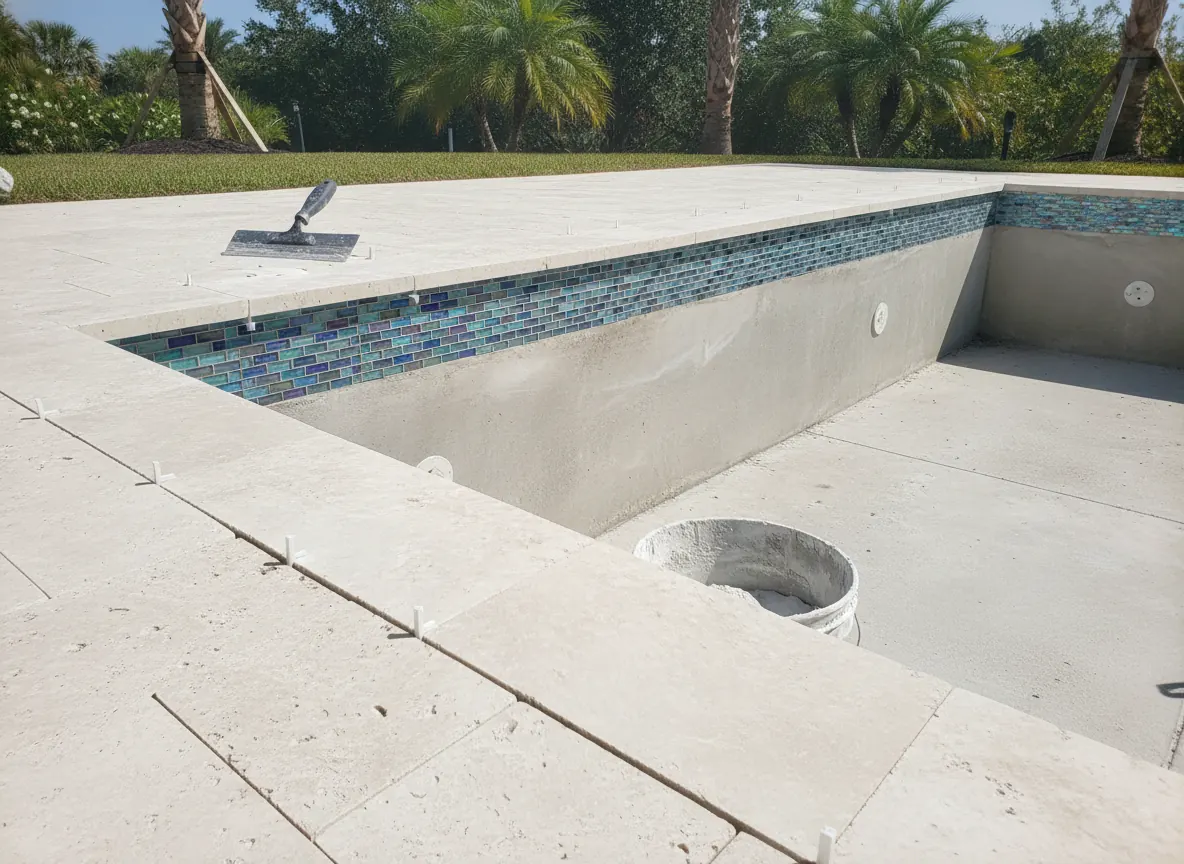
Tile usually runs in a band at the waterline, and it may also mark steps and depths. Common materials are porcelain, ceramic and glass. A 2022 Bob Vila cost guide prices glass tile material well above porcelain or ceramic. Homeowners in hard-water areas often ask how easy a tile is to clean, because calcium scale can build up along the waterline. Orlando Utilities Commission reports its water averages 129 ppm, about 7 grains per gallon; our Orlando hard water article explains what that does and does not tell you.
Coping
Coping is the cap along the top edge of the pool wall, where the pool meets the deck. Common choices include travertine, brick and cantilevered (poured) concrete. Because coping sits where the deck begins, a coping change often goes together with pool deck resurfacing, and the materials should be chosen so the edge and the deck look right together.
Typical prices
| Item | Typical range |
|---|---|
| Waterline or pool tile | $20–$50 per sq ft installed |
| Coping | $30–$80 per linear ft installed |
| Full tile interior | $20,000–$30,000 |
| Pool resurfacing, typical project | $6,000–$15,000 (about 1,000 sq ft of surface) |
| Travertine or paver deck | $12–$30 per sq ft installed |
| Draining | about $175–$225 |
Tile is priced by area and coping by the linear foot around the pool, so measuring the pool’s perimeter gives you a rough sense of scale before quotes arrive. No Orlando contractor publishes its own resurfacing prices, so local quotes are the only way to know a real number. For the full range of finish and deck prices, see the pool resurfacing cost guide.
When the bond beam needs repair
The bond beam is the top of the pool wall that the tile and coping sit on. If tile keeps falling off or coping keeps cracking in the same place, a contractor may look at the bond beam beneath it. One cost guide (HomeGuide) lists bond-beam repair, including tile and coping, at about $70–$80 per linear foot. That figure came from a search summary and could not be checked against the page, so treat it as a rough marker only.
Bond-beam work is work on the concrete structure, and that changes who can do it. A swimming pool/spa servicing contractor may not modify the concrete shell (CILB declaratory statement DS 2009-064), so structural repairs need a residential or commercial pool contractor. See pool remodeling and crack repair for related work.
Who may install tile and coping
In Florida, pool resurfacing is licensed pool contracting. All three state pool/spa license classes (commercial, residential, and swimming pool/spa servicing) list “interior finishes” or “interior refinishing” in their scope (Fla. Stat. §489.105(3)(j)–(l)), and the servicing class also covers draining a pool for repair or renovation. A servicing contractor may not modify the concrete shell (CILB declaratory statement DS 2009-064), so structural changes need a residential or commercial pool contractor. Plaster, tile and deck crews may hold voluntary pool specialty licenses (Rule 61G4-15.032), but they must work under contract to a licensed pool contractor.
Ask for the contractor’s state license number (it must appear in their ads and contracts, §489.119(5)(b)) and check it on MyFloridaLicense.com. A county business tax receipt is not a license.
For tile and coping, the relevant specialty is the voluntary “Trim” license in Rule 61G4-15.032, which is “limited to the installation of tile and coping.” Pool specialty contractors must work under contract to, and under the supervision of, a contractor licensed under §489.105(3)(j)–(l). In practice, that means the homeowner’s contract should be with the pool contractor, even if a tile crew does the setting.
Permit rules for resurfacing vary by city and county, and no Orange, Seminole or Lake county source we found states the residential rule in writing. Orange County has treated pool resurfacing as a pool renovation, and it requires a permit for new concrete or paver decks (pavers need a zoning permit). The licensed contractor confirms and pulls any permit required.
If the job is permitted, the inspector may check pool safety features. Ask your contractor.
HOA approval for visible changes
Florida law limits a homeowners association’s architectural review to what its declaration states or reasonably implies (Fla. Stat. §720.3035), and an association may not require a building permit before reviewing plans. Interior pool finish changes are often not visible from the street, but decks, pavers, coping and screen enclosures often are. A new coping material or color is the kind of change that may fall under review, so check your declaration and get ARC approval where it applies before work is scheduled.
Getting comparable quotes
Ask each contractor to list the tile and coping materials by name, the square footage of tile and linear footage of coping, whether the bond beam will be inspected, whether the water is lowered or the pool drained, and how drain water will be handled. Ask for the state license number on the quote. Then request free quotes with photos of the loose tile or cracked coping so contractors can see the job before they visit. You can also read more on pool tile and coping replacement.
Frequently asked questions
Can pool tile be replaced without draining the pool?
Research for this site found no source that answers this for every pool. It depends on how much tile is involved, where it sits and the contractor’s method. Ask each contractor whether they lower the water or fully drain, and why. If water is discharged, Orange County’s chlorine, pH and discharge-rate rules apply.
How much does pool coping replacement cost?
National cost guides put coping at about $30 to $80 per linear foot installed, and waterline tile at about $20 to $50 per square foot installed (HomeGuide, HomeAdvisor, Angi and Fixr). These are estimates, not quotes. The pool’s perimeter, the material and any bond-beam repair change the total, so compare written local quotes.
Who can replace pool tile and coping in Florida?
A state pool/spa contractor holds the contract. Rule 61G4-15.032 offers a voluntary “Trim” specialty limited to installing tile and coping, but specialty contractors must work under contract to a licensed pool contractor. Bond-beam or shell repair needs a residential or commercial pool contractor. Check any license number on MyFloridaLicense.com.