
Signs Your Pool Needs Resurfacing, and When an Acid Wash Is Enough
Rough plaster, repeating stains, flaking, cracks and loose tile each point to a different fix. Here is how to tell them apart and get quotes that match.
Orlando FL Pool Resurfacing is a free quote service. We connect Orlando-area homeowners with independent local pool contractors for free, no-obligation quotes. The contractor you choose quotes, contracts and does the work.
Pool finishes wear out slowly, so it is easy to miss the point where routine care stops helping. This guide walks through the signs homeowners usually notice first, when an acid wash may be all a pool needs, when the problem is structural, and how to line up quotes you can actually compare. For price ranges, see the pool resurfacing cost guide.
Common signs a pool finish is wearing out
None of these signs alone proves a pool needs a new surface. Each is a reason to have a contractor look and explain the options in writing.
A rough or etched surface
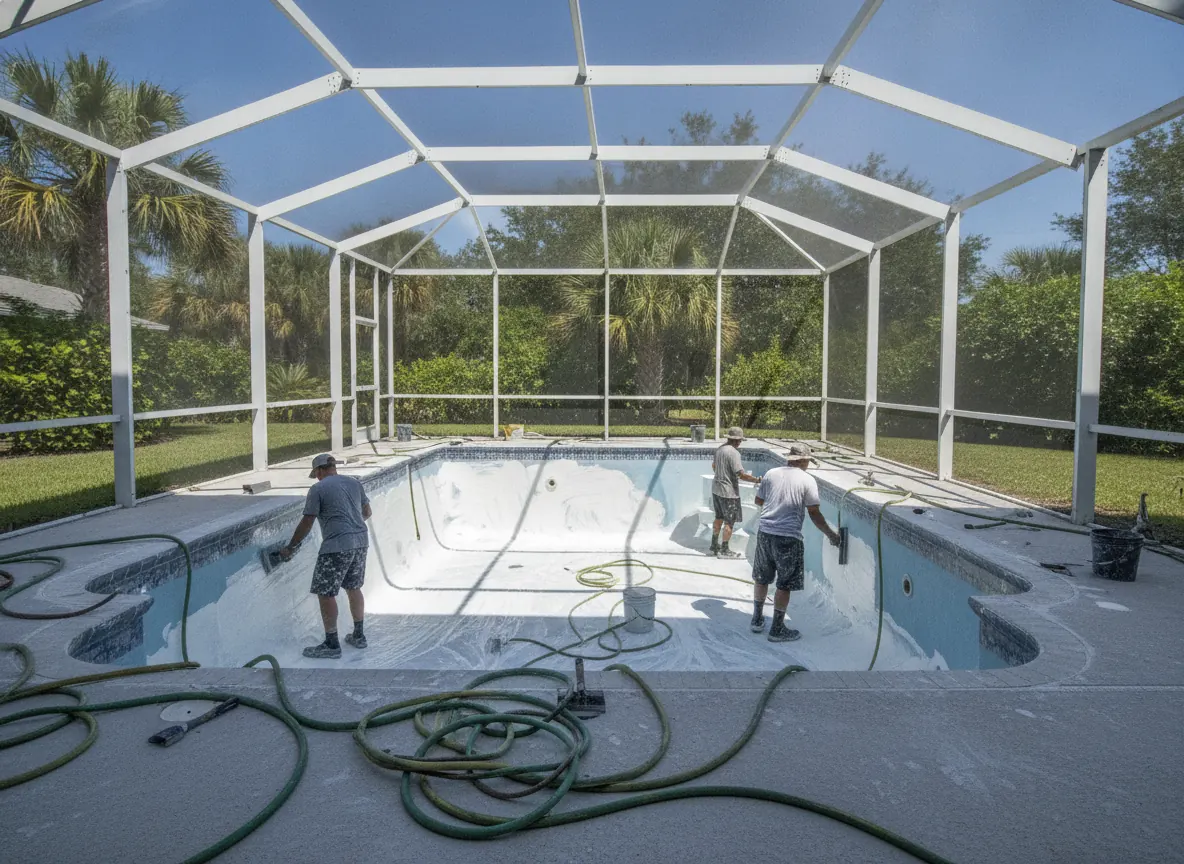
A finish that feels like sandpaper on hands and feet, or that looks dull and pitted, is one of the most common reasons people start asking about resurfacing. Etching like this is usually easy to see once the water is clear and the light is good.
Stains that keep coming back
Some stains brush away or respond to normal water care. Others return a few weeks after every treatment, or cover large areas of the floor and walls. Repeating stains are often the point where homeowners compare an acid wash with a full resurface.
Delamination and hollow spots
Delamination is when the finish layer separates from the surface beneath it. Homeowners may see flaking, peeling patches or small areas that sound hollow when tapped. Because the finish is no longer bonded in those spots, cleaning alone will not fix them.
Cracks
Fine surface cracks in the finish and cracks in the concrete shell are different problems. From the deck they can look alike, so a crack paired with a falling water level is a question for a contractor, not a cosmetic issue.
Loose or missing tile
Waterline tile that rings hollow, pops off or leaves gaps is a common reason a project grows from a resurface into a tile and coping job. Our tile and coping replacement guide covers that decision.
When an acid wash may be enough
An acid wash is a cleaning treatment for a drained pool. Orange County’s pool-pollution guidance describes muriatic acid as “used for etching the concrete pool interior,” which is why an acid wash removes a thin layer of the surface along with the stain. It can make sense when the finish is still smooth enough, well bonded and free of cracks, and the main complaint is discoloration.
Cost guides put an acid wash at about $300–$700 for most in-ground pools (HomeGuide, an estimate rather than a quote). That is far below the $6,000–$15,000 typical resurfacing project, so it is a reasonable first question to ask. It is not a fix for delamination, deep etching or structural cracks, and because it removes material, it is not something to repeat often on a thin finish.
Orange County’s muriatic-acid warning
Orange County warns that muriatic acid “will reduce the pH rapidly. A low pH will immediately kill plants and animals.” Its rules for discharging pool water to a lawn ask for these conditions first:
- Stop adding chlorine about 10 days before draining.
- Total chlorine of 0.01 mg/L or less.
- pH between 6.5 and 8.0.
- Discharge to the lawn at 25 gallons a minute or less, never to storm drains, streets or septic systems.
- Water contaminated with algae, debris or metals is pumped out by a sanitary service.
Approval from the St. Johns River Water Management District may also apply to dewatering. Ask any contractor how they will handle the drain water, the acid rinse water and the timing. Draining is usually planned outside the June–September rainy season, when about 57 percent of Orlando’s annual rain falls (NOAA 1991–2020 normals, Orlando International Airport). Trade publications such as AQUA Magazine and WaterShapes describe how groundwater pressing on an empty shell can crack or lift it, which is why contractors check groundwater and the hydrostatic relief valve before draining. That is trade practice, not law. Our guide to draining a pool in Central Florida has the details.
When the problem is structural
Some signs point past the finish to the shell itself: a crack that runs through the concrete, a water level that drops faster than evaporation would explain, or hollow areas across large sections. Resurfacing does not fix a leak. Leak detection usually comes first: the state contractor board found no facts showing a license is needed for electronic leak detection (CILB DS 2014-050), but the repair is licensed work.
In Florida, pool resurfacing is licensed pool contracting. All three state pool/spa license classes (commercial, residential, and swimming pool/spa servicing) list “interior finishes” or “interior refinishing” in their scope (Fla. Stat. §489.105(3)(j)–(l)), and the servicing class also covers draining a pool for repair or renovation. A servicing contractor may not modify the concrete shell (CILB declaratory statement DS 2009-064), so structural changes need a residential or commercial pool contractor. Plaster, tile and deck crews may hold voluntary pool specialty licenses (Rule 61G4-15.032), but they must work under contract to a licensed pool contractor.
Ask for the contractor’s state license number (it must appear in their ads and contracts, §489.119(5)(b)) and check it on MyFloridaLicense.com. A county business tax receipt is not a license.
That last distinction matters for structural work. A servicing contractor can resurface, but shell repairs, reshaping, and new steps or benches belong to a residential or commercial pool contractor. Two more points: contracts by unlicensed contractors are unenforceable by them (§489.128), and the Florida Homeowners’ Construction Recovery Fund (up to $30,000 for pool, or Division II, contracts signed on or after July 1, 2024) applies only to licensed contractors. See pool remodeling and crack repair and who can resurface a pool in Florida for more.
How to get quotes you can compare
Quotes are hard to compare when each covers a different scope. Ask every contractor to put the same items in writing:
- The finish: white plaster, quartz or pebble, and the color.
- The surface area the price is based on.
- How the old surface is prepared (for example, a full chip-out or a bond coat).
- Whether waterline tile, coping or deck work is included.
- Whether the main drain cover is replaced. A resurface is a natural time to ask about replacing an old cover with one that meets the federal Virginia Graeme Baker Act standard.
- The drain, discharge and refill plan, and who handles start-up.
- Who confirms and pulls any permit, and the contractor’s state license number.
Permit rules for resurfacing vary by city and county, and no Orange, Seminole or Lake county source we found states the residential rule in writing. Orange County has treated pool resurfacing as a pool renovation, and it requires a permit for new concrete or paver decks (pavers need a zoning permit). The licensed contractor confirms and pulls any permit required.
If the job is permitted, the inspector may check pool safety features. Ask your contractor.
| Item | Typical range |
|---|---|
| Acid wash | $300–$700 for most in-ground pools |
| Draining | about $175–$225 |
| Pool resurfacing, typical project | $6,000–$15,000 (about 1,000 sq ft of surface) |
| White plaster / marcite | $6–$8 per sq ft (about $6,000–$8,000 per 1,000 sq ft) |
| Waterline or pool tile | $20–$50 per sq ft installed |
Refill water is part of the cost too. For City of Orlando homes on OUC water, a 20,000-gallon refill adds roughly $47–$84 in OUC water volume charges depending on the rest of that month’s use, before sewer charges (OUC rate schedule effective Oct 1, 2026).
When you are ready, request free quotes and describe what you see: rough spots, stains, flaking, cracks or loose tile.
Frequently asked questions
How do I know if my pool needs resurfacing or just cleaning?
Look at how the finish feels and holds up. Stains that brush away or respond to water care point to cleaning. A rough or etched surface, flaking or hollow spots, repeating stains across large areas, or cracks point toward a contractor visit. Ask for a written opinion that says whether an acid wash, a resurface or a repair fits, and why.
How much does a pool acid wash cost?
Cost guides put an acid wash at about $300 to $700 for most in-ground pools (HomeGuide, 2026). That is an estimate, not a quote. Draining adds about $175 to $225 in national guides, and refill water depends on your utility and that month’s use. Orange County’s discharge and muriatic-acid rules apply to the water that leaves the pool.
Who should repair a cracked pool shell in Florida?
A residential or commercial pool contractor. A swimming pool/spa servicing contractor may resurface and drain a pool, but the state contractor board says a servicing contractor may not modify a pool’s concrete structure (CILB DS 2009-064). Ask for the state license number and check it on MyFloridaLicense.com before signing a contract.